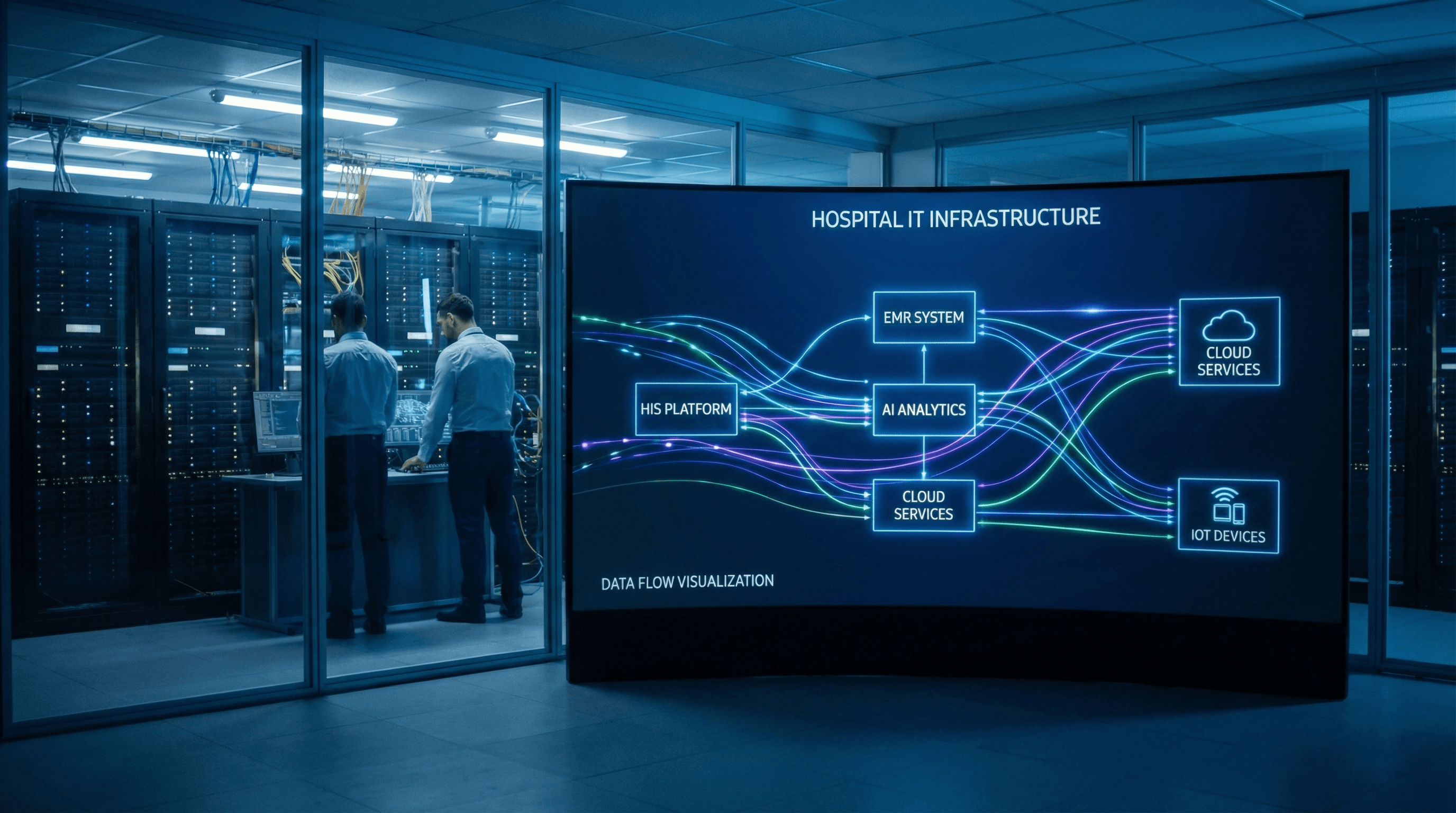
EMR & HIS AI Integration: Connecting Your Hospital Systems to AI
"We bought an AI chatbot that's supposed to help patients," the hospital CIO said, frustration evident in his voice. "But when a patient asks 'What time is my appointment?', it tells them to call us. We could have done that with a $5 webpage."
He's not wrong. A chatbot that can't access your systems isn't AI—it's a fancy FAQ page. And patients know the difference.
The hospitals seeing real results from AI aren't just deploying chatbots. They're connecting those chatbots to the systems that actually know patient information: the HIS, EMR, RIS, and LIS that contain scheduling, clinical data, lab results, and everything else.
That connection is where the magic happens. It's also where most implementations fail.
What Integration Actually Means
Let me show you the difference between an integrated AI and one that isn't:
Scenario: Patient asks "When is my next appointment?"
Without integration: "I'm sorry, I don't have access to your appointment information. Please call our scheduling department at 1800-XXX-XXXX."
With integration: "Hi Mrs. Chen! Your next appointment is with Dr. Wong on Thursday, January 15th at 2:30 PM for your follow-up consultation. Would you like me to send you a reminder, or do you need to reschedule?"
Same question. Completely different value. The second response takes the same AI platform but connects it to the scheduling system.
Now multiply that across hundreds of daily interactions. Every "please call us" response is a failure. Every personalized, data-driven response is a win.
The Systems That Matter
Healthcare data is spread across multiple systems. Understanding what lives where is the first step:
Hospital Information System (HIS):
The backbone of hospital operations. Contains:
- Patient registration and demographics
- Appointment scheduling
- Admission, discharge, transfer (ADT) events
- Billing and insurance information
- Room and resource management
For AI, the HIS enables: Real-time appointment booking, scheduling changes, patient identification, insurance verification.
Electronic Medical Record (EMR):
The clinical heart. Contains:
- Medical history and diagnoses
- Medications and allergies
- Lab orders and results
- Clinical notes
- Treatment plans
For AI, the EMR enables: Personalized prep instructions, medication reminders, lab result notifications, post-procedure follow-up.
Radiology Information System (RIS):
Imaging-specific data:
- Imaging orders and scheduling
- Study status tracking
- Report availability
- PACS integration
For AI, the RIS enables: Imaging appointment scheduling, prep instructions (fasting, contrast), results notifications.
Laboratory Information System (LIS):
Lab-specific data:
- Lab orders
- Specimen tracking
- Result reporting
For AI, the LIS enables: Lab appointment booking, results delivery, abnormal result alerts.
How Integration Actually Works
Healthcare systems speak specific languages. If your AI doesn't speak those languages, it can't communicate.
HL7 v2.x: The Workhorse
HL7 v2 is the most widely deployed healthcare integration standard. It's been around since the 1980s, and while not pretty, it works.
Messages that trigger AI actions:
- ADT^A01 (Patient admitted): Trigger welcome message, orientation information
- ADT^A03 (Patient discharged): Trigger discharge instructions, follow-up scheduling
- SIU^S12 (Appointment scheduled): Send confirmation, prep instructions
- SIU^S15 (Appointment cancelled): Offer rebooking
- ORU^R01 (Lab results): Notify patient, schedule follow-up if needed
When your HIS sends an SIU^S12 message (appointment booked), the AI should automatically send the patient a WhatsApp confirmation with relevant details. That's integration.
FHIR R4: The Future
FHIR is the modern standard—RESTful APIs with JSON resources. Easier to work with than HL7 v2, but not universally adopted yet.
Key FHIR resources for AI:
- Patient: Demographics, contact info (for identification)
- Appointment: Scheduling data (for booking, reminders)
- Encounter: Visit information (for personalization)
- Observation: Lab results, vitals (for notifications)
- MedicationRequest: Prescriptions (for reminders)
If your EMR supports FHIR (Epic, Cerner/Oracle, and others do), integration becomes significantly easier.
Proprietary APIs
Every major EMR has its own API ecosystem:
- Epic: MyChart APIs, FHIR R4
- Oracle Health (Cerner): Millennium APIs, FHIR
- MEDITECH: Web Services, FHIR
- Regional systems: Varies widely
The key question: Does your AI vendor have experience with your specific systems?
Three Integration Patterns
Based on dozens of hospital integrations, three patterns emerge:
Pattern 1: Direct API Integration
Architecture: AI platform connects directly to HIS/EMR APIs
Pros:
- Real-time data access
- Simplest architecture
- Lowest latency
Cons:
- Requires robust APIs from source systems
- Security exposure if not managed carefully
- Vendor-specific implementation work
Best for: Modern cloud-based systems with mature APIs (Epic, Cerner, newer regional HIS)
Pattern 2: Integration Engine
Architecture: AI connects to integration engine (Mirth, Rhapsody), which connects to hospital systems
Pros:
- Single integration point for AI
- Handles protocol translation (HL7 ↔ REST)
- Leverages existing hospital infrastructure
Cons:
- Additional middleware complexity
- Potential bottleneck
- Extra maintenance layer
Best for: Hospitals with existing integration infrastructure, multiple legacy systems
Pattern 3: Data Platform
Architecture: Hospital data replicated to analytics platform; AI queries the data platform
Pros:
- No impact on production systems
- Flexible data access
- Advanced analytics possible
Cons:
- Data latency (minutes to hours)
- Data governance complexity
- Additional infrastructure cost
Best for: Large health systems with data warehouses, analytics use cases
The Implementation Reality
Let me walk through what integration actually looks like for a typical hospital:
Phase 1: Discovery (1-2 weeks)
Inventory your systems:
- What HIS do you use? Version?
- What EMR? Is FHIR enabled?
- What's your integration infrastructure?
- Who owns each system? IT contacts?
Define data requirements:
- What data does AI need to read? (Appointments, patient info, results)
- What data does AI need to write? (Bookings, confirmations)
- What's acceptable latency? (Real-time for scheduling, batched for reminders)
Phase 2: Security Setup (1-2 weeks)
This is non-negotiable:
- Create dedicated service accounts for AI
- Implement least-privilege access (only data AI actually needs)
- Enable audit logging for all AI access
- Configure IP whitelisting
- Encrypt all data in transit (TLS 1.2+)
Documentation required:
- Business Associate Agreement (BAA)
- Security assessment
- Privacy impact assessment
Phase 3: Technical Integration (2-4 weeks)
API setup:
- Obtain credentials
- Configure authentication (OAuth, API keys)
- Set up test environment
- Implement error handling
Data mapping:
- Map source fields to AI platform
- Handle data type conversions
- Manage code set translations (ICD, CPT, SNOMED)
- Define default values for missing data
Testing:
- Unit tests for each integration
- End-to-end conversation tests
- Load testing for peak volumes
- Failover testing
Phase 4: Go-Live (1 week)
Staged deployment:
- Start with limited patient segment
- Real-time monitoring during launch
- On-call support available
- Documented rollback procedures
Ongoing monitoring:
- API health checks
- Data sync latency tracking
- Error rate monitoring
- Usage analytics
The Problems You'll Encounter
Every integration hits challenges. Here are the common ones and how to solve them:
Challenge 1: Legacy Systems Without APIs
The problem: Your 15-year-old HIS doesn't have a REST API. Or any API.
Solutions:
- HL7 interface engine (most legacy systems speak HL7)
- Database views (read-only access to underlying data)
- Screen scraping (last resort, fragile)
- Vendor engagement for API development
Challenge 2: Real-Time Data Needs
The problem: Your integration syncs overnight, but AI needs current appointment data.
Solutions:
- Event-driven architecture with HL7 triggers
- Change data capture (CDC)
- Polling with short intervals
- Hybrid approach (real-time for scheduling, batched for others)
Challenge 3: Multiple Sources of Truth
The problem: Patient phone number is in HIS, EMR, and billing system—and they're all different.
Solutions:
- Define source of truth per data element
- Master data management
- Conflict resolution rules
- Data quality monitoring (flag discrepancies)
Challenge 4: Performance Impact
The problem: AI queries are slowing down your production EMR.
Solutions:
- Read replicas for AI queries
- Caching frequently accessed data
- Rate limiting AI requests
- Off-peak batch operations
What Success Looks Like
When integration is done right:
- Patient asks "When is my appointment?" → AI responds with exact date, time, doctor, location, and prep instructions
- Patient receives lab results → AI proactively notifies them, offers to schedule follow-up
- Appointment is cancelled → AI immediately offers rebooking, manages waitlist
- Patient is discharged → AI sends personalized care instructions, schedules follow-up, checks in during recovery
This isn't a vision of the future. This is what's happening today at hospitals with properly integrated AI.
The Integration Checklist
Before you go live:
Pre-Integration:
- System inventory complete
- Data requirements documented
- Security assessment complete
- BAA signed with AI vendor
- API credentials obtained
- Test environment available
Integration Development:
- Authentication implemented
- Read APIs tested
- Write APIs tested
- Error handling implemented
- Logging configured
- Data mapping validated
Go-Live Readiness:
- Load testing complete
- Failover tested
- Monitoring dashboards ready
- Runbook documented
- Support escalation defined
- Rollback procedure tested
Bot MD Integration Capabilities
Bot MD has integrated with healthcare systems across Southeast Asia for years:
Pre-Built Connectors:
- Epic (MyChart, FHIR)
- Oracle Health / Cerner
- MEDITECH
- Major Asian HIS vendors
- Laboratory systems (Roche, Siemens, Abbott)
Standards Support:
- HL7 v2.x (all major message types)
- FHIR R4 resources
- REST API integration
- SOAP web services
Middleware Compatibility:
- Mirth Connect
- Rhapsody
- Microsoft Azure Integration Services
- Custom integration engines
Security & Compliance:
- SOC2 Type II certified
- HIPAA compliant
- PDPA compliant
- End-to-end encryption
Book a demo to discuss your specific integration requirements. We'll assess your current systems, identify the optimal integration pattern, and show you what connected AI can do for your hospital.
The difference between "please call us" and personalized, real-time responses is integration. And integration is something we do every day.